Showing posts with label Juicing. Show all posts

6/30/14

Minty Fennel Green Juice

One thing I hate about juice recipes is that they always call for fruit and veg by the piece.  I find that this yields extremely inconsistent results.  I’m very plan oriented, and I need consistency to plan appropriately.  To combat this, I’ve started documenting the average weights of fruit and veg so that I can use weight in my recipes (or convert those I find to use weight instead).  That way I always get the same amount of juice from a recipe.  And no chaos ensues in my kitchen.  No, that never happens…   

When I buy all of my produce over the weekend, I’ll wash, cut, and bag all of the produce up individually so it’s ready to be weighed and juiced at any time, with limited prep required. I find this saves a lot of time and doesn’t change the quality of the juice or lessen the quantity.  And as much as I hate single use items and plastic bags, I do love using plastic zip top bags to store my produce.  It keeps it all very fresh, and the space they take up shrinks as I use up the produce.  I die a little inside every time I throw one away, but you choose your battles, I suppose. 

I find a lot of great recipes on the rebootwithjoe site, which is where I found this one (don’t ask me where, because I can’t find it now).  It called for handfuls and pieces and stalks, so I converted everything to ounces.  I made a couple substitutions.  I used orange instead of grapefruit, dandelion instead of kale, and I used all parts of my fennel (bulb, stems, and leaves). 

I found this to be extremely refreshing for a green juice.  Usually green juices are…uhh… well… pretty fucking nasty.  This was pleasantly sweet and minty.  I will definitely be adding this to my regular juice rotation. 

Here’s the recipe by weight and by piece, in case you’re a fly-by-the-seat-of-your-pants kind of person. 
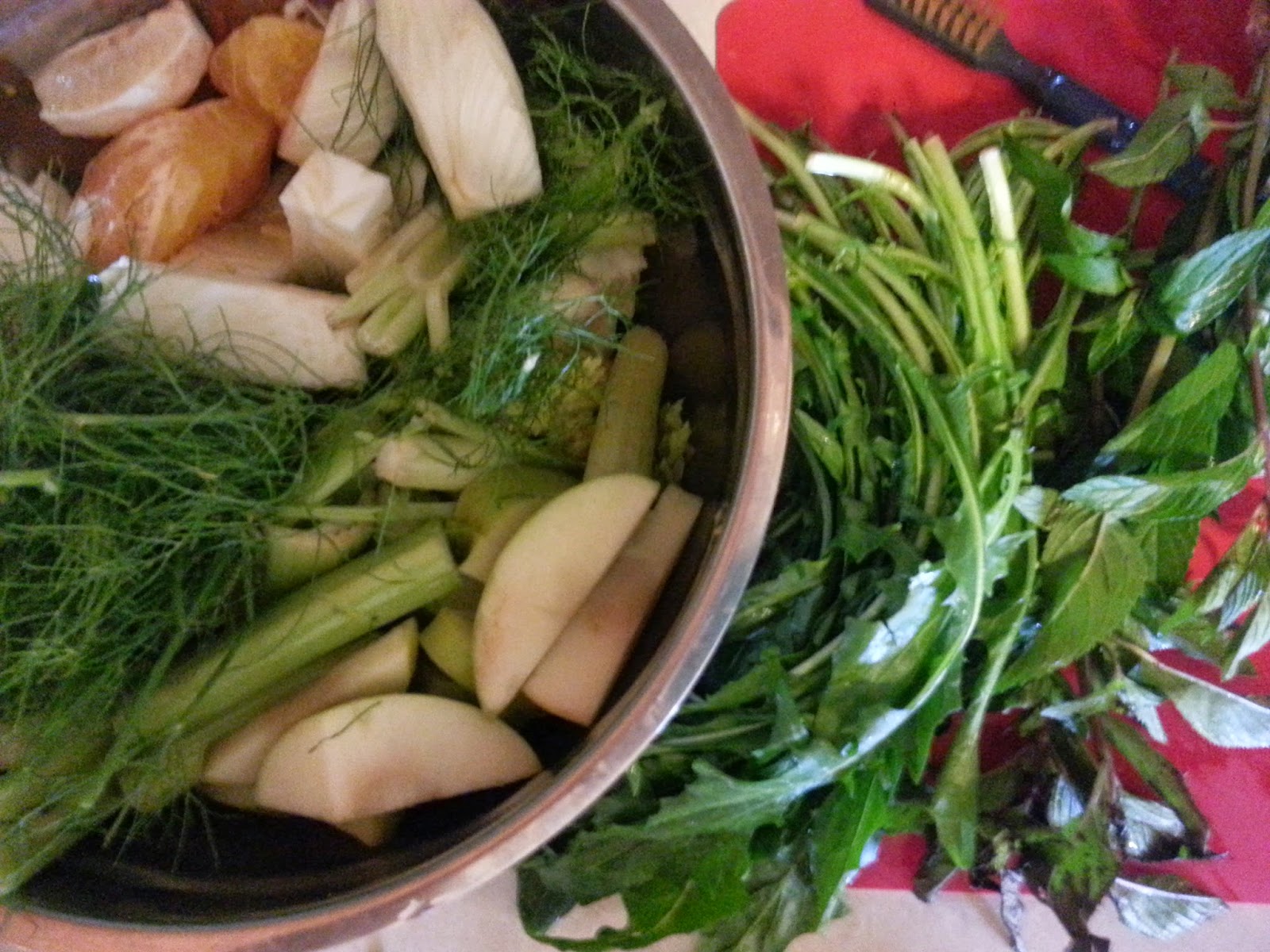
6.6 oz. orange (or 1 orange)
1 oz. mint (or 1 handful)
12 oz. celery stalks (or 6 stalks)
10 oz fennel bulb + 6 oz fennel stems/leaves (or 1 bulb fennel with all stalks and leaves)
1 lemon
16 oz. green apple (or 2-3 apples)
4 oz. dandelion greens (or ~1/2 bunch)


yields slightly more than 56 oz.

Cheers to good health!


Wondering about the nutritional value?  Here you go.  Want the TL;DR version?  This juice will give you super healthy blood, brain, bones, & skin, and might even help your vision. 

Dandelion greens give you a shit ton of vitamin K & A, a hefty amount of phosphorus, potassium, & calcium, and trace amounts of vitamin B & C, calcium, magnesium, manganese, and iron.  

Mint contains vitamin C, manganese, and copper.  Mint also aids in digestion and produces something called monoterpene which is said to slow tumor growth and prevent cancer formation in certain areas of the body. It also acts as an antioxidant and has antibacterial properties. 

Oranges, of course, contain vitamin C, but also vitamins A & B, potassium, and calcium. 

Celery contains vitamins A, B, C, K, and tons of minerals and antioxidants.  Celery also contains compounds which might help reduce nervousness and headaches. 

Fennel has quite a bit of potassium and vitamin C, and trace amounts of selenium and other minerals. The stems contain a solid mixture of B-complex vitamins. 

Apples contain B-complex vitamins, vitamin C, and trace amounts of minerals. They also contain quercetin, which acts as a powerful antioxidant. 


3/8/13

Juicing, and how to make it last


Yes, it’s been forever since I’ve last posted. No, I’m not going to bore you with how busy I was or what was keeping me from the blog.  What I am going to do is talk about juicing. 

As you might have guessed, I finally got that juicer which I’ve been coveting for some time now.  You know the one.  The Omega J8005.  She’s a beauty. 


You might be wondering why I chose this one over, say, one of the ever-popular Breville’s or the Green Star.  Or you might now be wondering what the heck the Green Star is. 

Okay, okay.  Let me start from the beginning. 

Centrifugal

I started off thinking I would, in fact, get a Breville centrifugal juicer.  The price seemed right, and hey, the Amazon ratings are pretty high, so how bad could it be?  Well, upon further research, I discovered that these centrifugal types are far more prone to oxidation than their masticating counterparts.  This is due to the way in which they work.  What they do, pretty much, is take the vegetables and spin them around and cut them up until the pulp is spun dry.  Then the pulp and juice are separated and ejected through their respective exits.  The problem with this is it’s not quite as efficient as most masticating juicers, which means waste.  If there’s anything in the world that I hate, it’s waste.  Immediately, my mind conjures up images of soggy pulp and wasted juice (and having to buy too much produce, and what that’s going to do to my grocery budget…and before I know it I’m in a full blown panic about going bankrupt.  All over soggy pulp.  My brain is a chaotic place…).  This is all extremely wasteful and I can’t really stomach that much waste (money, and food…and I guess nutrients, so TRIPLE NEGATIVE on these centrifugals), especially when I consider just how much I’m planning to juice.  The added expense over time of the wasted juice is simply not worth saving a few bucks right this second (the centrifugal juicers are typically much more “affordable” than the masticating juicers).  And apparently these suckers can be pur-itty loud.  I don’t know about you, but I have enough appliances trying to murder my ear drums.  I don’t think I need another. 

Masticating

My next logical step, of course, was to begin looking into masticating juicers.  This is where I found the Omega line of juicers.  Also in this category is a brand called Champion.  Some people like them, but in my research I determined the Omega to be better (for my uses), for reasons I am now unable to recall.  Go figure.  The masticating juicers work slower, but juice much more efficiently than the centrifugal types.  I can handle throwing in a few extra minutes of my time if it means higher quality juice, and more of it.  The pulp coming out of my machine (the Omega J8005) is dry as a bone.  The only time it’s at all wet is if I’m pushing too much food through the chute, which means I’m not giving the machine enough time to work its magic on the pulp already in the auger.  If I’m patient, I can’t squeeze a single extra drop of juice from the ejected pulp.  That auger thing I mentioned, that’s the other difference between the two types if juicers.  The masticating juicers work with an auger, which rotates to push and squeeze the juice from the veggies, working the ever-dryer pulp toward the spout, while excreting the (almost) pulp-free juice out the bottom of the compartment.

Others

There are also a few other models to choose from.  The Green Star, mentioned above, is basically the top of the line.  It can’t be beat as far as efficiency and juicing grasses and greens.  It also comes with a $500 price tag, so you get what you pay for here in the juicing realm.  Omega also makes an upright masticating juicer, which is sort of new technology on the juicing scene (or so I was to understand while doing my research).  I don’t really know too much about them, as I didn’t dig too deep into them.  The one I found was almost $400, so when I realized I could get everything I wanted for ~$250, I decided to quit while I was ahead and go with the Omega J8005 before I convinced myself that I did, indeed, need to spend $500 on a juicer. 

Juicing in Action

When I started talking to people about juicing, most people seem to share the opinion that juicing is too expensive.  So far, I beg to differ.  Let me give you a cost example for my most recent batch of juice.  I like a nice combo of cucumber, tomato, carrot, apple, parsley, and ginger.  I made a triple batch over the weekend to last me throughout the week.  Here’s what I used and what I estimate to be the cost of each:

(Keep in mind, it’s currently the dead of winter here in PA, so prices are a little higher than usual)

15 carrots:                           $0.90
4 green apples:                     $2.00
6 tomatoes:                          $5.50
3 large cucumbers:               $3.00
1 handful of parsley:             $0.15
2-3” chunk of ginger:            $0.25
TOTAL                              $11.80

This batch yielded 6 pint sized jars of juice.  For me, that equals 6 days’ worth of juice.  So that is less than $2 per pint of fresh vegetable juice.  I used to spend more than twice that amount on a 12 oz. mocha latte every day, so I count juicing as a bargain, both for my wallet and for my health. 

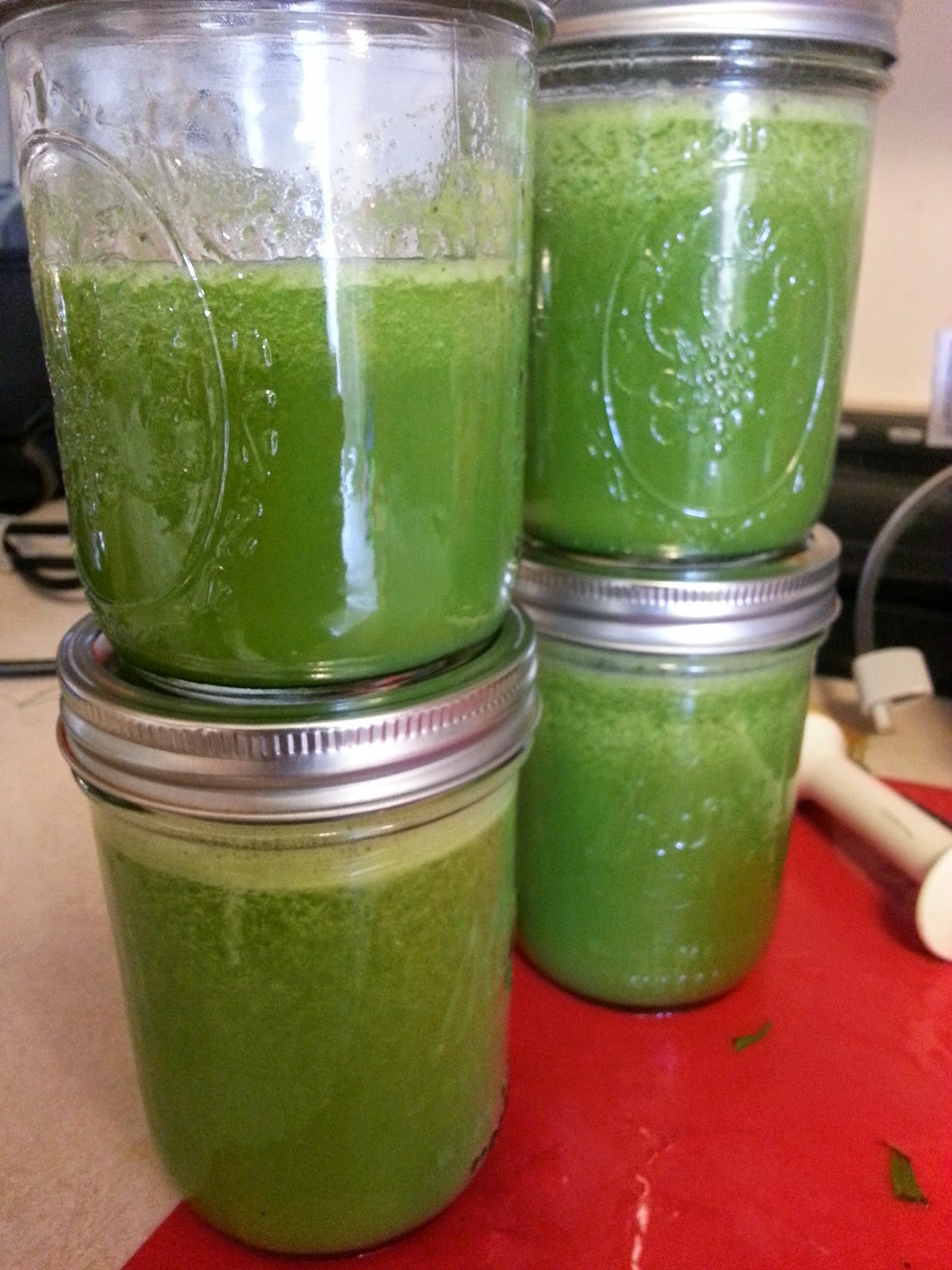
So it’s official.  I’m a juice convert, for sure.  I love having a fresh glass of juice every morning, ready and waiting in the fridge.  In case you’re wondering how I keep my juice for the entire week, I use my foodsaver with the widemouth jar attachment to “preserve” the juice.  I put preserve in quotes because it’s not technically preserving, since it still requires refrigeration, but this method will keep your juice fresh for at least a week.  A week is the longest I’ve let sealed containers of juice hang around, so I can’t yet speak to the quality of juice contained for longer periods of time.  I will bet that the juice will last longer, though, because I didn’t notice any degradation of flavor at the 6 day mark.  I do highly recommend sealing your juice in mason jars, as it saves a lot of time to prep, juice, and can a weeks’ worth of juice at once, instead of chopping and cleaning 7 days a week. 

Have any juicing know-how of your own to share?